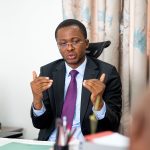
Seif Soud at Emerson-Hurumzi Zanzibar, in the process of potraying an African Woman, combining cultural depth and artistic precision.
In a sunlit corner of Stone Town, Zanzibar, where the scent of the sea mingles with echoes of Swahili songs and the shadows of carved wooden doors dance across coral stone walls, you might find Seif Soud, brush in hand, breathing life into canvas.
Yet few would guess that just over two decades ago, this celebrated painter was elbow-deep in motorcycle engines, unsure if his art would ever move beyond the margins of a notebook. His journey from grease-stained fingers to gallery walls is a true testament to persistence, passion, and the quiet power of self-belief.
“When I left the garage,” he recalls, “it felt like walking into my real life for the first time.” Such stories are always interesting to hear, but more compelling to meet the people in flesh. Seif Soud was born and raised in Zanzibar, where the Indian Ocean shapes not only the coastline, but the character of those who live beside it. Growing up in the culturally rich neighborhood of Mwembeladu in Unguja island, Seif was immersed in a world of traditions, rhythms, and colors.
“I’ve been drawing for as long as I can remember,” he says. “Even as a child, I knew this wasn’t just a hobby, it was part of who I was.” One of his earliest influences was a neighbor, Soud Shindano, who drew images in notebooks and even on the ground. Watching Shindano work planted a seed. “He was better than me then,” Seif laughs. “But he inspired me to keep going.”
Seif Soud is a devoted father of two including a son and a daughter whom he credits as constant sources of love, inspiration, and perspective. “They remind me every day why art matters,” he says, “because it helps build a better world for those we love.”
Whether he is sketching in his studio or attending a school play, Seif finds profound meaning in the everyday moments with his children. Their curiosity and imagination fuel his passion for artistic expression and motivate him to contribute positively to the world they’re growing up in. Although Seif now speaks of family, love, and legacy, his path to art was built long before fatherhood — tracing back to the day he left the garage and dared to pick up a brush. After finishing secondary school in 1993, Seif assumed that drawing wouldn’t earn him a living.
When I left the garage,” he recalls, “it felt like walking into my real life for the first time.”
He turned to motorcycle repair for work until a friend encouraged him to visit the Old Fort in Stone Town, a place known for fostering local artists. “That year of training changed everything,” Seif says. “It taught me not just how to draw better, but why I draw in the first place.”
By 2001, he had become a working artist, able to support himself through his craft. While he didn’t attend a formal art school, Seif considers himself largely self-taught, shaped by years of dedication and refinement.
Once he stood fully in his identity as an artist, the next chapter was discovering the distinct language he would use on canvas — the themes, style, and mode of expression that would carry his voice. Seif’s work is rooted in the beauty and complexity of Zanzibar. His canvases echo island life. “My art is a dialogue between Zanzibar’s layered identity and my personal creative voice,” he explains. “Every painting is a story about culture, about beauty, about memory.”
He primarily works with oil and acrylics, valuing their different qualities. “Oil gives me richness and depth,” he says, “while acrylic lets me move fast, experiment, and adapt.”
Locally, Seif holds great respect for the late taarab singer, instrument player and artist Seif Salim, whose portraits deeply moved him. Internationally, he draws inspiration from Marthandam Rajasekharan, an Indian painter known for his realistic style and mastery of emotion. Yet Seif’s style remains uniquely his own an intricate blend of narrative, culture, and craftsmanship. “I want my paintings to feel alive, like they’re speaking to you,” he says.
Among his most notable work is a deeply personal and symbolic painting of Hon. Dr. Hussein Ali Mwinyi, the current President of Zanzibar, alongside his late father, Mzee Ali Hassan Mwinyi, Tanzania’s former president (1985–1995) and Zanzibar’s leader from 1984 to 1985.
“This piece is more than a painting—it’s a visual dialogue between generations,” he reflects. “It
honors a legacy while embracing the leadership and optimism embodied by President Hussein
Mwinyi today.”
It’s a work that not only captures likenesses but also encapsulates the continuity of public service, vision, and the enduring values shaping Zanzibar’s future. “For me,” he adds, “this painting stands as both a personal milestone and a tribute to the ideals that continue to define our national story.”
With his portfolio of distinctive, meaningful works building notice among art lovers and institutions. Seif’s work has been shown widely from local venues like the House of Wonders in 2002, to Emerson on Hurumzi in 2020 and 2022, to international stages like Cape Town (2010) and Ohio, USA.
Having achieved strong visibility and success through exhibitions and sales, Seif is now turning his attention outward — toward legacy, mentorship, and building opportunities for others. He doesn’t just want to create art; he wants to nurture it in others. “There are many young talents in Zanzibar,” he says, “but they lack access to tools, training, and opportunity.”
“When someone looks at my painting,” Seif reflects, “I want them to feel something connection, emotion, understanding. I want them to see the story, but also the skill. And maybe, just maybe, find their own reflection in the canvas.”
Beyond what Seif hopes to convey, there remains room for interpretation — not just of his work, but of himself. We are yet to see challenging his own self by drawing his own picture and let that picture and himself go into dialogue if the sides in question can enter into conversation on the best of this artist who is surely going to enter into history annals of Zanzibar.

Business Psychology Sales & Corporate Culture
Email: fatumussa@gmail.com