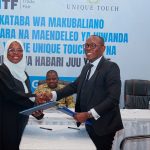
Hon. Zubeir Ali Maulid (right), the Speaker of the Zanzibar House of Representatives, and Member of the House of Representatives, Hon. Mihayo Juma N’hunga (left), inspecting shoes manufactured by the Industries of the Special Departments during their visit at the two day exhibition held at the grounds of the House of Representatives in Chukwani, Zanzibar (Photo by: Othman Maulid).
For a cost effective, reliable and quality locally produced garments, Zanzibar’s Special Department Industries stand as the cornerstone for empowering both government institutions and private entities.
This enterprise that began by producing uniforms for Zanzibar security forces, has expanded significantly in both scope and ambition.
Now it operates several specialized units including a garment and lace factory, shoe factory, non-woven bag and packaging factory and a printing factory. Together, these facilities offer a one-stop solution for institutions seeking everything from tailored uniforms and protective footwear to branded accessories, packaging printed materials and even embroidered emblems.
Today, it serves a wide range of public and private clientele with a commitment to high-quality standards, offering products that include uniforms, shoes, bags, cultural garments and promotional materials all made locally and competitively.
Clients in sectors like hospitality, construction, security, and education can benefit from an end-to-end production process, including design, fitting, finishing and customization all done in-house.
Located at Mtoni area in Unguja Island, the industries are not limited to supplying Zanzibar alone. Through partnerships with local traders, products reach mainland Tanzania and even cross borders through export arrangements, showcasing the growing footprint of this local powerhouse.
For cost-effective and locally grounded, institutions that choose to work with Special Department Industries can expect clear savings. For example, a pair of imported military boots might cost up to TSH 160,000, while a locally made equivalent from the factory costs approximately TSH 75,000.
Similarly, a full imported uniform might fetch TSH 150,000, but this manufacturer can produce the same for TSH 80,000 almost half the price.
These savings are not merely financial. Local production minimizes the logistical complications of importing, such as delays, taxes, return costs, or fitting issues. Uniforms and footwear can be sized and tested on-site, drastically improving fit and quality.

Mr.Ramadhan Ibrahim (second right), the Managing Director of the Industries of the Special Departments, leads the Speaker of the House of Representatives, Hon. Zubeir Al Maulid (second left), and other members of the House during the two day exhibition held at the grounds of the House of Representatives in Chukwani, Zanzibar (Photo by: Othman Maulid).
“Our operations illustrate a practical implementation of the Zanzibar’s Industrial Policy’s vision: to grow Zanzibar’s manufacturing sector by sourcing locally, increase exports, generate employment, and build a competitive, diversified economy.” said the Special Department Industries Managing Director, Mr. Ramadhan Ibrahim.
All industries and sector can benefit from locally crafted staff uniforms that reflect Zanzibar’s unique cultural aesthetics. This is particularly appealing for businesses wanting to reinforce a strong brand identity while supporting local industry.
“Our products that reflect local cultural designs carry the “Made in Zanzibar” label, which not only reflects our cultural authenticity and craftsmanship, but also appeals in tourism markets and among consumers who wish to support Zanzibar’s economy,” said Mr. Ibrahim.
He added that, “Whether you’re outfitting staff, supplying branded goods, or offering unique retail lines, working with our industries gives you responsiveness, flexibility, lower logistics overheads and the opportunity to differentiate with a product that reflects Zanzibar’s heritage.”
For NGOs working in community services, fieldwork and outreach, the factory offers sturdy, customised and safety gear at competitive prices. Security and construction sectors often require durable, protective clothing and footwear. Special Department Industries produces work boots, high-visibility clothing and rugged uniforms built to withstand demanding conditions.
From promotional bags to printed materials, the factory supports local businesses in marketing and operations. Custom to taste bags, branded shirts and printed banners help companies improve visibility while keeping procurement costs low.
The factory currently produces over 3,300 pairs of military uniforms, 3,100 pairs of military boots, 1,200 graduation gowns and over 13,000 square meters of printed textiles. Though these numbers show healthy performance, the factory’s target volumes are higher, a sign of both ambition and potential for scale.
Our operations illustrate practical implementation of the Zanziba’s Industrial policy Vision.
Production is supported by a team of skilled tailors, machine operators, designers and administrative staff, totaling over 170 personnel. These employments contribute directly to the local economy. “The contribution to public revenue has been substantial. The company spent over TSH 121 million in inputs procured from local SMEs and paid TSH 18,163,000 million in direct tax last year alone,” explains Managing Director.
To compete with imported products, Mr. Ramadhan Ibrahim pointed that the factory maintains rigorous quality standards. All products comply with regulations from the Zanzibar Bureau of Standards (ZBS). In fact, the factory participates in the product certification scheme, allowing it to label products with the Zanzibar Bureau of Standards (ZBS) standards mark of quality, ensuring buyers that the goods meet standards and are subject to regular testing.
The industries are actively seeking partnerships in technology transfer, market expansion and co-branding. Investors, donor agencies and private enterprises have a unique opportunity to support a venture that delivers economic returns while contributing to Zanzibar’s industrial and social development. Choosing local organisations not only save money and time, it also invests in a resilient, skilled and self-sufficient Zanzibar.
With the capability to deliver garments, footwear, bags and print materials tailored to the needs of clients across sectors, the factory is more than a clothing producer. It is a key partner in building a stronger, more independent local economy.

Mass Communication & PR Strategists (PR, Creative Content Design & Media Management)