Bet al Amani (Peace Memorial Museum) in Zanzibar, a graceful, white washed landmark sel in the heart of Stone Town. Built in 1925 in memory of lives lost in World War’t its gant dorme and arabesque windows reflect a fusion of architectural influences and the island’s enduring spint of peace and reconciliation.
Whitewashed walls, a dome glowing against the tropical dusk, and arched windows casting silent outlines — the Peace Memorial Museum, known locally as Beit el Amani (‘House of Peace’), stands at the southern edge of Stone Town as both a sanctuary and a story in stone.
As it marks its 100th anniversary, the museum remains a powerful symbol of remembrance, reconciliation, and Zanzibar’s layered identity.
A Design born of grief and vision
Commissioned in the aftermath of the First World War, Beit el Amani was conceived as a living memorial to honor all those who sacrificed their lives during the Great War. A pledge to end all wars. The idea was not only to mourn but to educate, to enshrine peace in stone, sand and cement.
The design was entrusted to British engineer-architect J. H. Sinclair and government architect P. C. Harris, who envisioned a structure that would harmonize with Zanzibar’s cosmopolitan landscape. Built on a hexagonal plan, the museum’s central dome is surrounded by six smaller domes, each symbolizing unity and continuity.
The arabesque windows filter sunlight into serene spaces, while the sweeping symmetry evokes global icons such as the Hagia Sophia and the Taj Mahal — making Beit el Amani not only a local landmark but an architectural bridge between worlds.
On Armistice Day in 1925, a solemn crowd gathered as Sultan Seyyid Khalifa bin Haroub inaugurated the memorial. The ceremony blended the formality of empire with local traditions — an acknowledgment that even in distant Zanzibar, the wounds of the war had left indelible marks. From that moment, Beit el Amani became more than a monument; it became a meeting point between memory and hope, a place where peace was not simply commemorated but continuously reimagined.
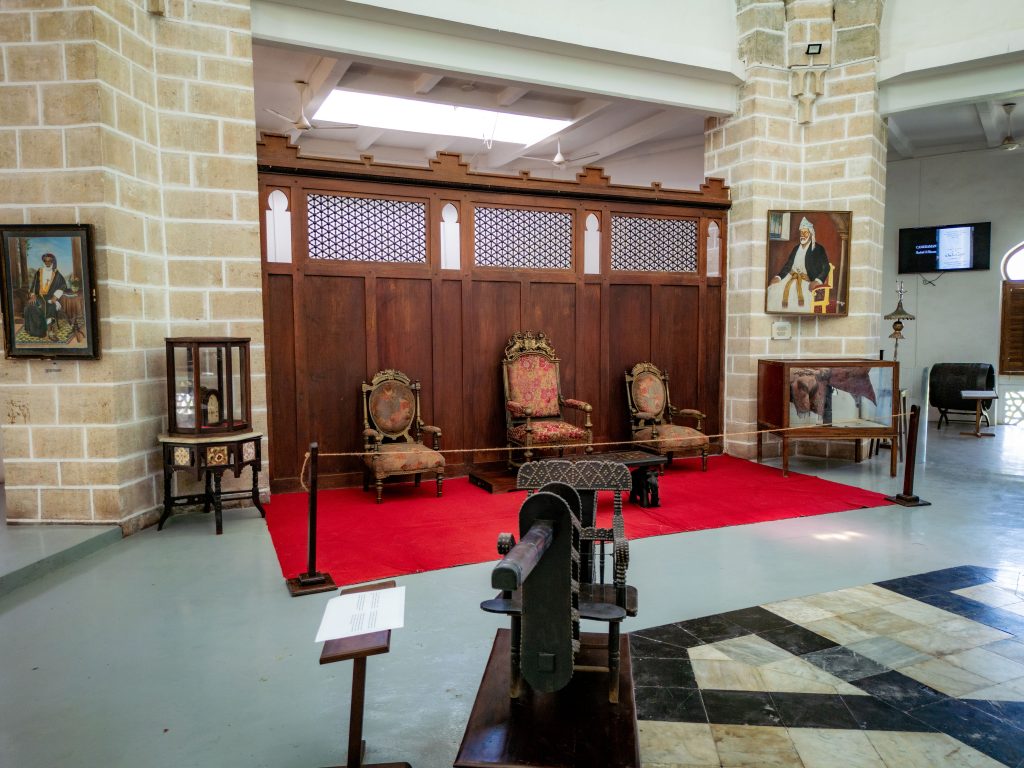
On display in the interior gallery of the Peace Memorial Museum are artefacts dating to the early 19th century. Top right is a painting by local artist Abdullah Farhan (1959) portraying Sayyid Said Bin Sultan (1804 1856). Bottom right: The Sultan ceremonial saddle and standard, richly embroidered and mounted in brass, a gift from the Sherif of Mecca. These items speak to Zanzibar’s historical role as an international mercantile hub linking East Africa, the Arabian Peninsula and beyond.
Zanzibar’s rich heritage
Inside, the museum’s galleries unfold like chapters of a vast history. Omani Sultan relics, explorers’ journals, archaeological finds, and artifacts of daily life narrate centuries of exchange and adaptation.
Among the standout exhibits are a 19th century Arabic-inscribed drum, intricately carved doors— relics that evoke Zanzibar’s role as both crossroads and crucible of cultures.
Beit el Amani is not only a local landmark but an architectural bridge between worlds.
The collection captures not only the grandeur of sultanate rule and colonial encounters but also the everyday artistry of Swahili craftsmanship. It offers visitors — local and international — an intimate lens into how Africa, Arabia, India, and Europe converged to shape the island’s story.
Architecture as living memory
Architecturally, Beit el Amani is inseparable from Stone Town’s heritage, its coral rag stone walls and domed silhouette blending into the city’s tapestry of palaces, mosques, and trading houses. As part of the UNESCO World Heritage Site, the museum stands as a guardian of continuity amid rapid modernization.
While its displays have evolved over time, the building itself remains an artifact — a tangible link between Zanzibar’s past and present. The museum’s preservation is not just an act of conservation but a reaffirmation of cultural identity, ensuring that history remains visible in the very materials that built it.

This part of the museum displays a rickshaw Rickshaws were used by the wealthy to go to desired destinations. After the revolution of 1964, almost all of them were bunt to ashes, except this seen on the left. Mounted on the right is the painting of the Hungarian Emperor Franz Joseph (1848 1916), painted by J. Kiffs of Vienna, 1888, The painting was presented to the Sultan of Zanzibar on the occasion of the signing of a commercial treaty between Zanzibar and the Austro Hungarian Empire in 1887.
A symbol of peace and reconciliation
From its inception, Beit el Amani has carried a message that transcends history: peace as the foundation of community. Its Arabic name — Beit el Amani — embodies the aspiration to transform loss into unity. Over the decades, the museum has served as a quiet forum for dialogue, learning, and reflection, reminding all who enter that reconciliation is as much a practice as it is a memory.
Today, as Zanzibar continues to navigate economic growth and cultural change, the Peace Memorial Museum stands as a moral compass — its domes and arches pointing not only toward the past but toward the enduring possibility of peace as a lived reality.
Practical details
Reopened in May 2024 after a major restoration, the museum now features refreshed exhibits and interpretive displays. It is located in Mnazi Mmoja, near the intersection of Creek Road and Kaunda Road, and sits within walking distance of the Natural History Museum — another stop for visitors exploring Stone Town’s heritage circuit.
Balancing memory and modernity
As Beit el Amani enters its second century, the question it poses is timeless: how can this timeless mark of our history serve the present? In preserving both heritage and humanity, Zanzibar’s House of Peace continues to offer an answer—quietly, enduringly, and in a golden light of the present day to the far horizons of our prosperous future.